Finding Pleasure and Purpose in Parkinson’s

Michele Keir’s First Painting Completed in 2018
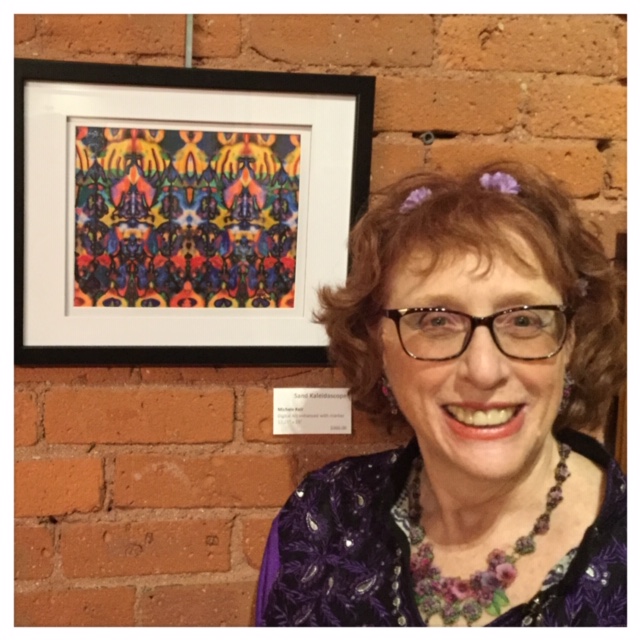
Artist Michele Keir

How It All Started

“When I was five years old I overheard my kindergarten teacher tell my mother I am an artist. I knew from that moment on,” says Michele Keir. Mr. Robertson, who was her art teacher in both seventh and twelfth grades, was a graduate of Pratt Institute. He was the biggest influence on her educational choices. She grew up in New York and graduated from Pratt Institute with a bachelor of industrial design and a concentration in advertising design and pottery electives. While at Pratt, Michele won the 1968 Alumni Day banner competition where she experimented with juxtaposing colors and patterns. To this day she describes ”learning that out of all the talented freshmen at Pratt I was one of four artists to win that Alumni Banner competition is her most amazing moment as an artist. I only entered the contest because it was mandatory.”
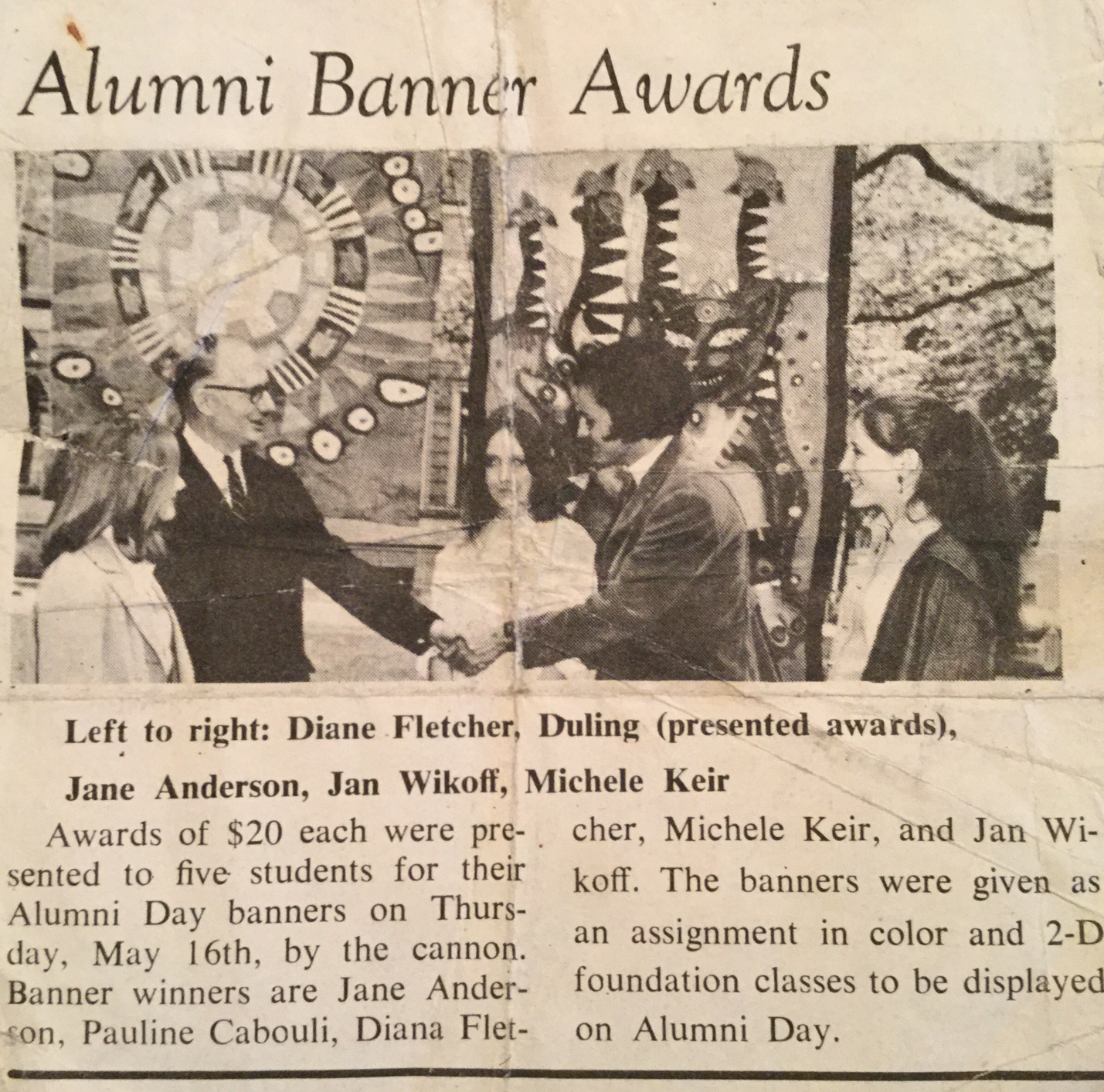
Love Affair with Color and Pattern Begins

Blessed to Work in Art Field

Michele graduated during the 1971 recession and oil shortages. She was the only one in her department at Pratt who got a design job at graduation. She started in the Art Department of Hasbro and had the distinction of creating the images of the first two production years of the ”Weebles Family.”

She was dating her husband-to-be and dressed the father Weebles similarly to him. “He was the first “preppie” I had ever dated. Everyone else wore denim,” she says. She worked for Hasbro followed by Milton Bradley for six and one-half years. From there, using her training from both Pratt Institute and Rhode Island School of Design to be a creative problem solver and inventor and to never stop a train of thought, she made a career as a graphic designer, product designer and potter.

Finding Pleasure and Purpose in Parkinson’s

However in 2013, she was forced to retire due to Parkinson’s disease. Michele was no stranger to this disease. Her father died after a three-year struggle with Parkinson’s just before she began classes at Pratt. Although genetics is a rare reason for getting Parkinson’s, Michele’s brother and sister also eventually became PWP.

Painted Nails Inspire Abstract

Years ago, when Michele was first diagnosed, she discovered painting her nails stopped her tremor. “I was painting wild designs on my nails years before it became vogue. One day I noticed my nails looked like my tulip garden and  I took a photo of my hand with the flowers behind. Then, for no particular reason, I uploaded the photo and used my computer graphics knowledge to abstract the image. I was intrigued and compulsive about creating this way. I just painted my nails, photographed my left hand in different parts of my house and had fun abstracting the images until I saw something I liked.”

All the designs were derived from photos of Michele’s tremor hand. She printed and framed the images and sold inexpensively with an average price of $50 donation to American Parkinson’s Disease Association. In the end, she raised over $12,000 for Parkinson’s research.  She did not keep any money to cover her costs. “Except for my husband paying for my expenses, this was a one woman fundraiser,” she says.

Another Pleasure and Purpose of Parkinson’s
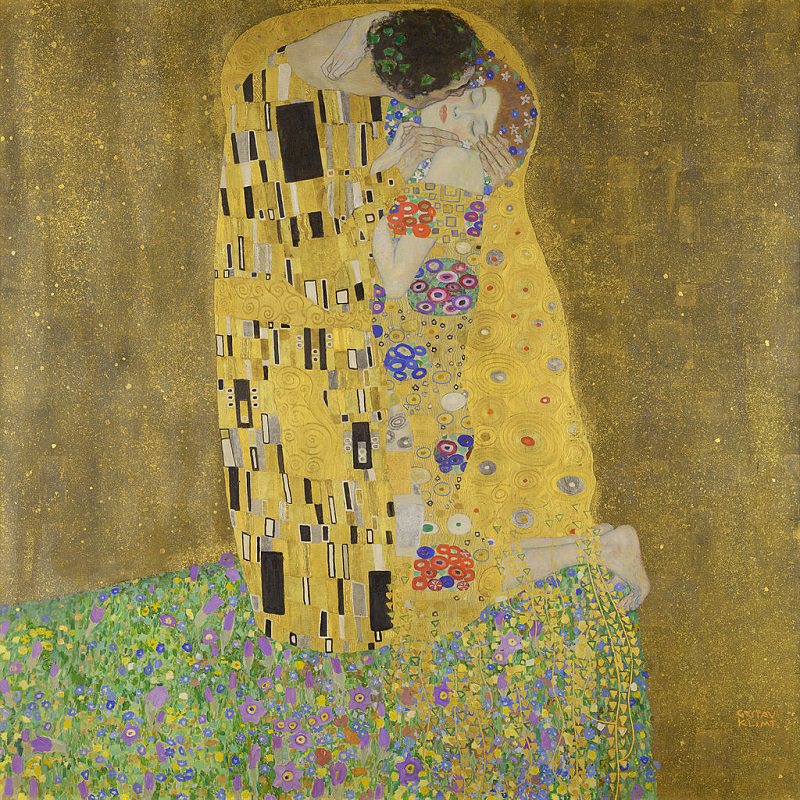
The Kiss by Gustav Klimt, Photo credit www.gustav-klimt.com

This past year Michele started to create art as a kind of personal therapy to take her mind away from the reality of Parkinson’s. The Austrian artist, Gustav Klimt was one of her favorite artists during college because of his use of patterns and colors. Her favorite Klimt painting, The Kiss set in a profusion of patterns and colors has reemerged to influence Michele’s art. She also recalls appreciating Lee Bontecou’s three-dimensional art at the Museum of Modern Art when she was a student. “I never anticipated being a fine artist. I didn’t think I could create without a reason. Never before have I created art without a teacher, boss or client limiting my creative process. It is liberating to not have to please anyone but myself. Having disposable income to buy my materials and having unlimited time to experiment are big contributors,” she says.
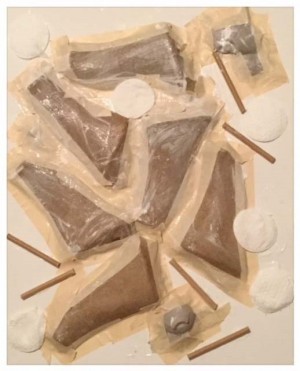
Blue Dog

Michele is always evolving techniques and style. “The only constant seems to be my love of color and creating things unconsciously from my mind. I am an innovator. I surprise myself.” For example, she did not set out to create a blue dog in relief/assembled style. “I glued down found objects to a canvas and just started painting patterns. I kept turning the canvas around until the dog jumped out at me. I attribute that technique (if you can call it that) to Mr. Robertson, my seventh grade art teacher,” she explains.

Home Studio

Studio Creations–Miniature Portraits for 70th Birthday

“I create at all hours of the day and night at my home studio in Warwick, Rhode Island. Parkinson’s decides that for me as I am awake a lot at night,” says Michele. When walking downstairs to her studio became problematic, she relocated her studio in her daughter’s former room. Michele is preparing for her 70th birthday party by painting a miniature portrait  place card for each of her guests.

Happy 70th Birthday

Photo Credit: Nick Stephenson

According to The Lion King lyrics, it’s the circle of life, and it moves us all through despair and hope,  through faith and love, till we find our place, on the path unwinding. In the Health Monitor–Guide to Living with Parkinson’s Disease magazine, Michele Keir is interviewed on tips and adaptations that keep her active and fulfilled. She emphasized “use all the tools available to you.” Turning to art is one of her go-to tools. In essence, she has returned to her love of color and pattern this past year that inspired her creations at Pratt Institute over five decades ago.

What a rewarding and productive year she has had! As a result of this joyous endeavor, her home is overfilled with her explosive art. In an attempt to have her art seen by others, she began entering local juried exhibitions the latter part of 2018. Michele’s art is already exhibited in eight places the first six months of 2019. She also has four “one woman shows” scheduled through November. When she discovered an April invitation, she responded, “It is my great pleasure to be offered this one woman show at The Gallery @Sprout CoWorking in Warren. This exhibition is the best seventy year birthday present I never expected! “  See video below.

Keeping in Touch

If you would like to contact Michele to purchase a creation, arrange an exhibit or see her additional work, please visit her website or email her at  [email protected]

Question: Pretend you are attending one of her exhibits. What would you ask Michele?

It has been Parkinson’s My Way’s pleasure to publish this interview on Michele’s 70th birthday and during Parkinson’s Awareness month.

Blessings!
Linda

 

Robin Morgan Parkinson’s Poems


When poet Robin Morgan found herself facing Parkinson’s disease, she distilled her experiences into these four quietly powerful poems — meditating on age, loss, and the simple power of noticing.  This Ted Talks presentation has over one millions views.

My favorite is This Dark Hour at the 9:25 mark.  Here are a few of the poignant lines that touch my soul.

4 a.m…I need no light, I know the way….there is this hour, poem in my head, soil in my hand, unnameable fullness…lived to this moment, immeasurable lightness…likely I’ll lose my way…all was unbearably dear and when I’m done with daylights…let them remember that I had this hour, this dark perfect hour.

Blessings!
Linda


Parkinson’s Awareness and National Poetry Month Connection


April is Parkinson’s Awareness month focused on spreading the word, educating yourself and supporting the cure. Five years ago what I knew about Parkinson’s amounted to very little. I equated the disease with tremors and knew about Mohammed Ali, Michael J. Fox and Janet Reno. However, when I was diagnosed with PD in 2014, I learned there was far more to this disease than trembling. In fact, I do not even have tremors. In 2017, I created a website and blog, Parkinson’s My Way….Creativity in Motion to educate, to inspire and to give hope.

I also discovered a connection between Parkinson’s and creativity which helped explain my sudden interest in writing poetry. I have been blessed to winning awards, being published, studying under presidential inaugural poet Richard Blanco and studying under Mississippi poet laureate Beth Ann Fennelly since my diagnosis.

April is celebrated by the Academy of American Poets as National Poetry Month, in celebration of writing, reading and enjoying poetry and those who make it. It was first created in 1996 to encourage people to read poems, support poets and help teachers introduce their students to the form.

To kick off this first week of Parkinson’s Awareness Month and National Poetry Month, I refer you to a guest blog I was invited to write for the National League of American Pen Women in 2017 on My Parkinson’s Muse. It later appeared in an anthology, The Creative Genius.

Question: What is happening in your community that supports Parkinson’s Disease Awareness or National Poetry Month?

Blessings!
Linda


Learning to Write Again with Parkinson’s

I text and word process. However, technology has not replaced my need to occasionally sign my name on a check or to fill out a form in the doctor’s office. Neither has technology smothered my desire to send handwritten cards and letters to my friends and family. However, Parkinson’s has affected my ability to write legibly 24/7. Micrographia, known as small and cramped handwriting, is the reason as presented in a recent blog “Can You Read My Tiny Handwriting?” But the good news is that some people with PD can write well when on medication, and many can learn to write all over again by practice, exercise and therapy.

Writing Tools and Supplies

Select the appropriate writing instrument for your needs. Gel pens flow easily across the page and are less likely to grab at the paper. Do you prefer light, medium or heavy tips? When you shop for a pen, hold it as you will when writing. Is the grip comfortable? Is the pen slippery? Do you prefer a rubber grip? Consider the weight of the pen. If you tremor, a heavy weight pen may work better for you.

Consider the use of lined paper to guide you in writing straight. Large lined paper will also make writing easier as you fill in the lines with letters. As writing improves, you can graduate to normal spaced lines or no lines! You may always prefer placing lined paper under the plain top sheet as your secret writing crutch.

Gather up items that relate to your writing project such as addresses, return labels, stamps, cards, stationary, lined paper and checkbook.

What Works for Me

I opt for a medium point gel pens over ballpoint pens. Shopping for pens is a fun activity for me. I like to write in colors such as green, turquoise, navy blue and red. I do not have tremors, so a regular weight pen is fine. I use lined paper in spiral notebooks to write everything from poems to doctor’s remarks to webinar notes. The lined paper tip reminds me of what I have done for students with high test anxiety especially on essay questions. I draw a box and ask them to write in the box which is less intimidating than a blank page. The same premise is true when learning to write again.  While researching this blog topic, I found a complimentary 3-page download on “Improve Your Cursive Worksheet” designed by Lindsey Bugbee.  I can tell already that it is a terrific tool. I remember similar paper from Mrs. Cole’s first grade class to help with placement and size of letters! Finally, getting up and down multiple times to find an address or a postage stamp is distracting. So I prepare in advance.

Where to Write

Set up on a flat surface such as desk or tabletop and not your lap. A firm chair is preferable to provide support and to encourage you to maintain good posture (another problem area for Parkinson’s people). Consider times of the day that you may be distracted by noise such as lawn service or by family members. If you find soft background music soothing, set up before starting to write. You should also consider location to ensure you have the advantage of natural light.

What Works for Me

I often write in the dining room where the view overlooks the patio, pool and tropical landscape. I sit as straight as possible at the dining room table. The dining chair works well and and provides firm support. The lighting is appropriate. This location is a change of pace from my third story office. Morning distractions include services such as the housekeeper, lawn crew and pool guy; however, these are manageable. I need quietude  when I am writing.

When to Write

Plan to write when you are in peak performance, that is when your meds are working and you are not having an “off period.” You will be happier with the end product and less frustrated. Do a few simple warm-up finger, hand and shoulder exercises before starting to write. Before signing your name on the get well card, doodle first on a scrap of paper. Write for short periods of time, take a break and resume writing. Avoid writing at the end of the day when you are tired and your meds are about used up for the day. Day rather than evening may be preferable for your writing projects.

What Works for Me

I do my handwritten notes and letters in the morning unless service companies are a distraction. I am well rested and dopamine is flowing freely through my brain from my morning dose of carbidopa levadopa and Azilect. My mother suffered from arthritis. Sometimes it took her several days to finish her handwritten letters to me. I can still hear her comment, “I’m no good today.” Sometimes that’s the way it is living with Parkinson’s. Finger exercises such as opening and closing hand and shoulder shrugs help me warm up before writing. I double check that I am in top writing form by doodling and writing a few words.

Adaptation

If you are signing a myriad of forms or checks every month, consider having a rubber stamp made. Pre-printed inserts may be the way to go for such writing as a holiday letter. Instead of writing, you may need to word process a note or letter and only hand sign your name. Imprinted return labels are easily made. Watch for marketing from associations who include labels for your use in hopes of donation. Some people with Parkinson’s print better than they  write. Some also report that when they close their eyes, they write legibly.

What Works for Me

I use a pre-printed thank you form to tuck into my customers’ purchases for my eBay business. I hand write their name at the top and sign my name on bottom. I add a couple of handwritten sentences to customize. When I write to friends, I usually word process the letter since it is often a couple of pages. I purchased a voice activated software system in 2015 when I had some Parkinson’s challenges. But as my medicine was tweaked and I practiced handwriting therapy, I decided this adaptation was premature. So I sold the software! I print as often as I write. Writing with my eyes closed does not work for me!

Handwriting Training

Practice, practice, practice. According to occupational therapist Uzma Khan, writing one practice page daily can help you manage and improve your writing. Do the daily writing in a dated journal so you can review your progress. Think big when you are writing. Exaggerate the letters. Before you start writing, do some finger stretches. Set an alarm for ten minutes and start writing the months of the year or names of relatives or lines from a book. Alternate between cursive writing and printing. Your printing may be far better. Every two to three minutes, you can rest for a few seconds.

Strength and flexibility exercises for your hands, fingers and wrists should be part of your routine. Squeeze your fists and hold for ten seconds. Flick your hands open and stretch your fingers as far as part as possible. Squeeze a ball or hand grip. Wring out a wet cloth and have someone else wring it to see how much water you left. Shuffle and deal cards. Play jacks. Google Parkinson’s handwriting exercises, and you will find many YouTube videos and other therapy resources. They are easy and fun to do. Positive results are possible.

Dr. Sarah King, PT, DPT at Invigorate recommends a Hand Booster exercise to help writing. Do as follows: (A) Clench a strong fist, then spread your fingers wide apart. Repeat 10 times on each hand. (B) Touch the tip of your thumb to the tip of each finger consecutively. Repeat 10 times on each hand. (C) Spread your fingers wide in a “stop” position, then push your palm down flexing at the wrist. Repeat 10 times on each hand.

What Works for Me

I think big letters when I write. Or I say “write big” just as I might say “heel toe, heel toe” if I am not walking properly. I no longer do a one-page written/printed practice page daily—only when I decide I need a refresher course! My yoga teacher has me write the alphabet letters in the air with my feet doing both print and cursive. I do the same with my fingers. I tap my fingers together as fast as I can, squeeze a ball in my hand, wring a wet cloth and open and close my fingers. I raise and lower my wrists. These exercises and more can be done while I watch television, stand in line in a store or sit in stalled traffic.

How are you learning to write again?

Blessings!
Linda